Reflective Project Journals: How to Review Work Without Judgment
The purpose of reflective journals
A reflective project journal is a disciplined way to capture what happened during a creative project. Rather than delivering verdicts, it records decisions, experiments, and observed outcomes. The aim is to make learning explicit so future work benefits from present discoveries.
Structure the review with simple prompts
Use a consistent set of prompts to keep reflection focused and usable. Try questions such as: What was I trying to learn? What decisions did I make and why? What surprised me? What would I change next time? These prompts reduce the risk of broad, vague conclusions and point directly to actionable insight.
Make space for description before evaluation
Start each entry with a neutral description: medium, tools, steps taken, and observable outcomes. Delay evaluative language for a later section. This order helps separate factual recording from emotional reaction and often reveals useful information that would be lost if early judgment shapes the account.
Use thumbnails and timelines
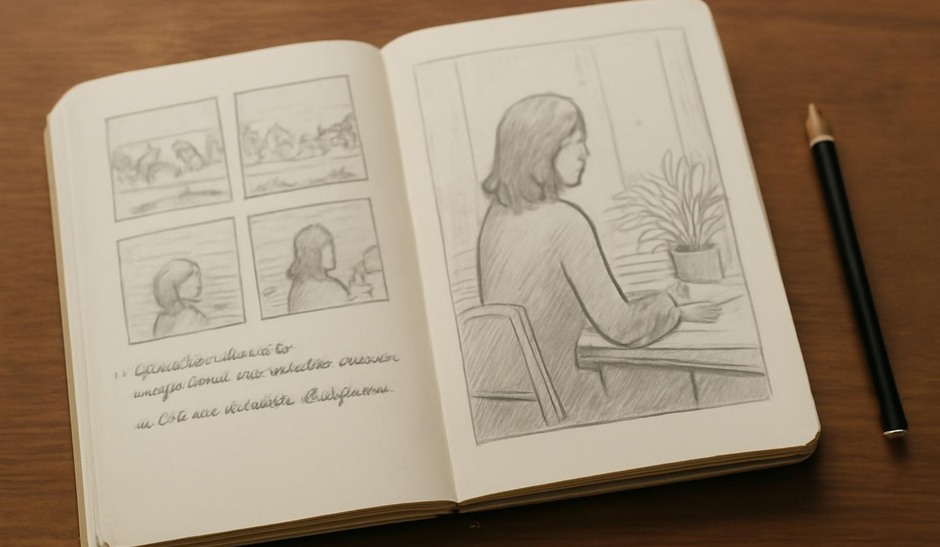
Small thumbnail sketches document sequence and composition choices. A simple timeline notes how long steps took and when decisions occurred. This visual shorthand is quick to produce and especially valuable when reconstructing the development of complex pieces.
Capture material behaviour and constraints
Note how paper, pigments, or tools behaved. Did a particular brush leave an unexpected texture? Did a colour darken on drying? Recording material responses helps when you return to similar techniques later and prevents repeating avoidable surprises.
Frame problems as experiments
When something feels off, reframe it as an experiment that yielded data. Rather than saying “this failed,” record what was learned: the limits of a technique, an unexpected interaction between media, or a compositional choice that weakened focus. This language encourages curiosity and continued iteration.
Summarise with an action list
End each entry with a short action list: specific, modest steps you might try next. Actions could include testing a different ground, adjusting relative scale, or limiting your palette to three colours. These next steps make reflection forward-looking and practically useful.
Review entries periodically
Schedule a quarterly review of journal entries. Patterns will emerge—techniques that recur, materials that require attention, and compositional tendencies. These reviews inform practice without imposing rigid goals; they help you refine habits and choose future experiments with more clarity.
Reflective project journals turn immediate impressions into durable knowledge. They are tools for impartial observation—records that respect the complexity of making and invite steady, informed development.